Business

Senate Bill 1383 - Short-lived Climate Pollutants (SLCP): Organic Waste Reductions – SB 1383:

The City of Brea, along with every jurisdiction in the State of California, is required by State law to implement an organic waste recycling program. California Senate Bill (SB 1383) requires reductions of organic waste in landfills as a part of a greater plan to reduce emissions of short-lived climate pollutants, such as methane. In addition, the bill requires that all residential and commercial (multi-family & business) customers have in place a three-stream container system consisting of trash, mixed recycling, and organics (yard/food waste). 

Additionally, certain commercial edible food generators must also donate edible food to edible food recovery organizations. More information on SB 1383 can also be found on the CalRecycle webpage at California’s Short-Lived Climate Pollutant Reduction Strategy or the Republic Services webpage.

  • How businesses can comply: subscribe to recycling and food waste recycling services through Republic Services by emailing OCRecycles@republicservices.com or calling (714) 238-2444. There are many container sizes available to fit the needs of your business. The City, and/or Republic Services, can assist with evaluating your waste and recycling needs and help you ‘right size’ your containers. 
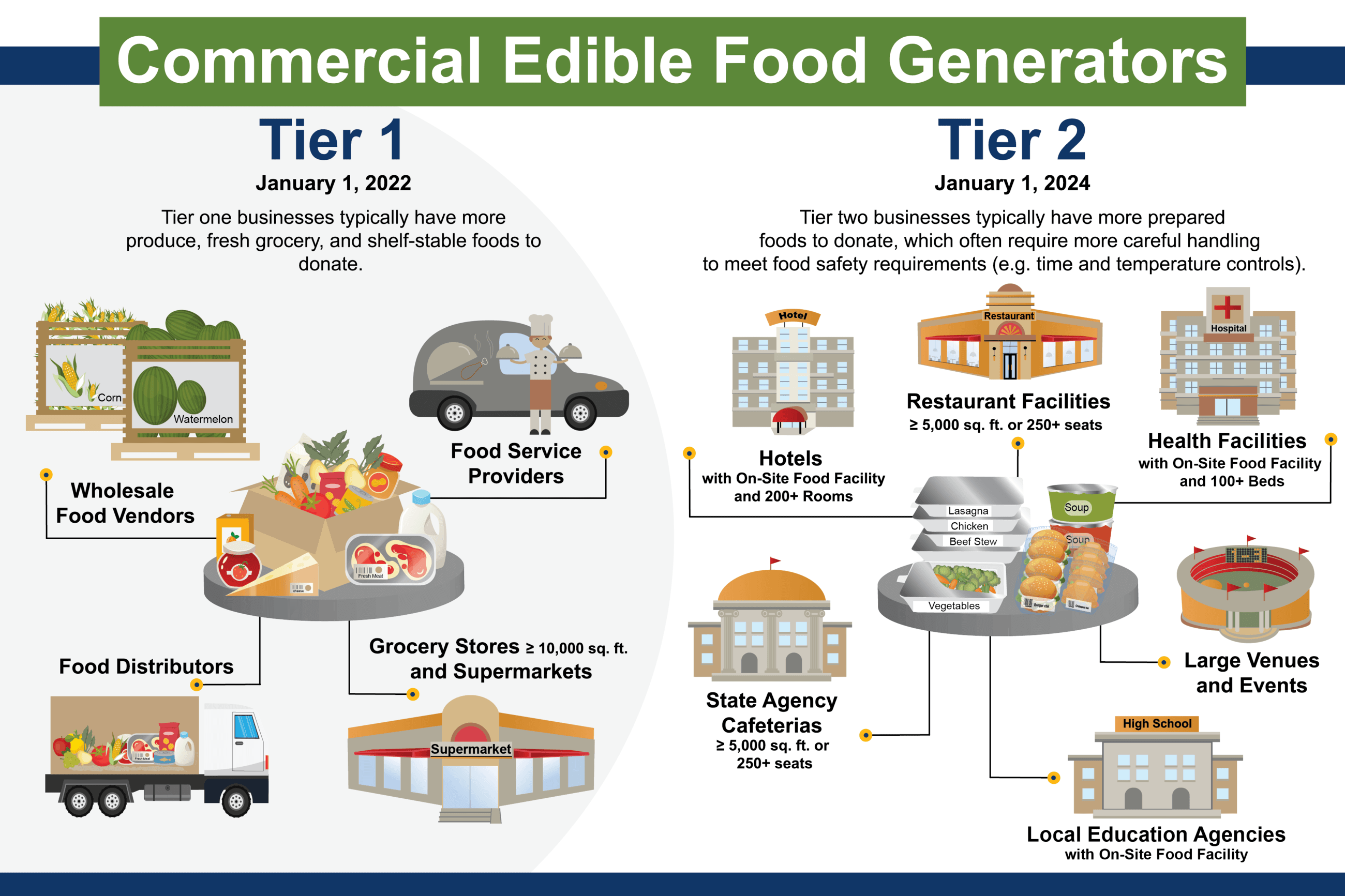
  • Edible Food Recovery:  Aside from organic waste recycling, SB 1383 requires mandated businesses to recover the maximum amount of edible food to be donated to edible food recovery organizations (EFRO’s). Businesses that generate donatable edible food are called ‘edible food generators’ and are broken into two tiers depending on the type of business. Detailed information can be found at the CalRecycle website.

SB 1383 Commercial Recycling Materials:

Edible Food Recovery Requirements:
sb-1383-edible-food-generators-01


Tier 1 Edible Food Generators
Tier 2 Edible Food Generators
  •  Grocery stores – Stores that are 10,000 square feet or more in size and primarily engaged in the retail sale of canned food, dry goods, fresh fruits and vegetables, fresh meats, fish, and poultry. Any area that is not separately owned within the store where the food is prepared and served, including a bakery, deli, or meat and seafood department must also comply.
  • Supermarkets - Full-line, self-service, retail stores with gross annual sales $2,000,000 or more that sell a line of dry grocery, canned goods, or non-food items, and some perishable items.
  • Food service providers - Entities primarily engaged in providing food services to institutional, governmental, commercial, or industrial locations through a contractual arrangement with the organization.
  • Food distributors - Companies that distributes food to entities including, but not limited to, supermarkets and grocery stores.
  • Wholesale food vendors – Businesses engaged in the wholesale distribution of food, where food is received, shipped, stored, or prepared for distribution to a retailer, warehouse, distributor, or other destination.
  •  Restaurants with 250 or more seats, or a total facility size equal to or greater than 5,000 square feet.
  • Hotels with an on-site food facility and 200 or more rooms.
  • Health facilities with an on-site food facility and 100 or more beds.
  • Large venues - Permanent venue facilities that annually seat or serve an average of more than 2,000 individuals within the grounds of the facility per day of operation. A venue facility includes, but is not limited to, a public, nonprofit, or privately owned or operated stadium, amphitheater, arena, hall, amusement park, conference or civic center, zoo, aquarium, airport, racetrack, horse track, performing arts center, fairground, museum, theater, or other public attraction facility. A site under common ownership or control that includes more than one large venue that is contiguous with other large venues in the site, is a single large venue.
  • Large events - Events, including, but not limited to, a sporting event or a flea market, that charge an admission price, or are operated by a local agency, and serve an average of more than 2,000 individuals per day of operation of the event, at a location that includes, but is not limited to, a public, non-profit, or privately owned park, parking lot, golf course, street system, or other open space when being used for an event. Refer to this flyerfor more information.
  • State agencies with a cafeteria that seats 250 or more or has a total cafeteria facility size equal to or greater than 5,000 square feet.
  • Local education agencies with an on-site food facility.


  • What is Edible Food?
    • Edible food is food intended for people to eat. This includes food not sold due to its appearance, age, freshness, surplus, etc. Edible food includes, but is not limited to,  prepared and packaged foods, as well as produce. All edible food must meet the food and safety requirements of the California Retail Food Code
  • What Does "Food Recovery" Mean?
    • Food recovery means collecting edible food that would otherwise go to waste and redistributing it to feed people in need. The best use for surplus food is using it to feed hungry Californians which ultimately conserves resources and reduces waste thrown into landfills. 
  • Why Recover Edible Food?
    • Save Food: California's send over 11 billion pounds of food t landfills each year, some of which was still fresh enough to feed people in need. While billions of meals go t waste, millions of California's don't have enough to eat. (Visit CalRecycle website for more information.)
    • Feed People: During the COVID-19 economic crisis, over 9 million Californians (23% of California's population) didn't know where their next meal would come from. (Visit CalRecycle website for more information.)
    • Fight Climate Change: landfills emit 20% of the state's methane, a climate super pollutant 84 times more potent than carbon dioxide. This comes from the breakdown of organics like food scraps, yard trimmings, paper, and cardboard. Reducing organic waste in landfills will have the fastest impact on the climate crisis. (Visit CalRecycle website for more information.)
  • What Food Can be Donated?
    • Food that is fit for consumption can and should be donated. This includes food that is edible but was not sold or set out because of surplus supply, appearance, age, freshness, grade, etc. Do not attempt to donate any food that is spoiled or otherwise unfit for human consumption or has been opened from its original packaging (unless individually wrapped) and is not "edible."
    • Food that can't be donated must be composted through Republic Services' organics program, or through other arrangements that are documented. Compliance is mandatory and failure to comply with state regulations may result in fines or other enforcement actions.
      • As long as you donate in good faith, your business is protected by the State and federal Good Samaritan Food Donation Acts. 
  • Recordkeeping Requirements:

    • A copy of contracts or written agreements with each Food Recovery Organization/Service
    • A list of each Food Recovery Organization/Service that collects/receives edible food
    • The name, address, and contact information for each Food Recovery organization/Service used
    • The types of food donated to each Food Recovery Organization/Service
    • The established frequency of food donations to each Food Recovery Organization/Service
    • The quantity of food donated to each Food Recovery Organization/Service, in pounds, by month (with backup)

Requirements for Commercial Edible Food Generators can be found by visiting CalRecycle's Food Donor webpage.        

The following is a list of Edible Food Recovery Organization's that are located within Brea as well as a few regional organizations:

Food Recovery Organization

Address

Collection Service Area

Contact Information

Foods Accepted

Christ Lutheran Church

820 W. Imperial Hwy

Brea

Brea

JoAnne Sloan, (714) 993-4129
 Laura Harton, (714) 529-2984

lharton@christbrea.com 

Only accepts food from Second Harvest Food Bank.

Jill's Pantry

Small food pantries at local elementary schools

Brea

Libby Blood, (714) 471-6446 

contact@jillspantry.com

Packaged non-perishables.

Brea Senior Center

500 Sievers Ave

Brea

Brea

Rebecca Matta, (714) 990-7753

rebeccam@cityofbrea.net

Fruits/veggies, meat, eggs/dairy/dairy alternatives, cooked baked/prepared perishables, packaged non-perishables.

Active Christians Today (St. Angela Merici Church)

585 S. Walnut Ave.

Brea

Brea

Yarmniz Garcia, (714) 529-1821

Please contact St. Angela Merici Church for details of foods accepted.

Second Harvest Food Bank

8014 Marine Way

Irvine, CA 92618

Serving All of Orange County

Visit Website

info@feedoc.org

(949) 653-2900

Nutritious food, including fresh fruits and vegetables, eggs, dairy, meat and grains, shelf-stable items like beans, canned meat and fish.

Abound Food Care

200 N Tustin Ave

Santa Aa, CA 92705

Serving All of Orange County

Visit Website
(855) 700-9662

Perishable and non-perishable foods including produce and prepared meals.

OC Food Bank

11870 Monarch St Garden Grove, CA 92841

Serving All of Orange County

Visit Website

Kristin Kvesic 

kkvesic@capoc.org 

(714) 897-6670 x3604

Food in original packaging, unopened and within their food code date/extension guidelines.

Share Our Selves (SOS)

1550 Superior Ave Costa Mesa, CA 92627

Serving All of Orange County

Visit Website
(949) 270-2100

Fresh produce, meats, dairy products, breads and assorted canned goods.

Chefs to End Hunger


Serving All of Orange County

Visit Website

info@chefsendhunger.org 

Please contact Chefs to End Hunger for details of foods accepted.

Food Finders

10539 Humboldt St

Los Alamitos, CA

90720

Serving All of Orange County

Visit Website

(562) 283-1400 x105

info@foodfinders.org

Dairy and bakery items, produce, deli, meats, and prepared items, along with canned and packaged goods.

Brackens Kitchen

13941 Nautilus Drive
Garden Grove, CA
92843

Serving All of Orange County

Visit Website

Volunteer@BrackensKitchen.com

714.554.1923

Meats, prepared food, baked goods, refrigerated goods, non-perishable food, produce.


Food Waste Prevention Resources for Businesses

Keep up with the newest available food prevention resources to see how California's businesses are complying with SB 1383.

Organization

Service

 Best suited for...

Too Good to Go

  • Allows your business to list daily surplus food on the Too Good to Go app, so clients can buy it (at a discount) through the app and pick it up at the time of your choice.
  • Grocery stores, restaurants, bakeries, catering companies, etc.

 Leanpath

  • Offers food waste measurement and tracking technologies, helps your business implement food waste prevention (such as through improved inventory management, menu optimization, etc.), including 
     through staff training and coaching.
  • Offers food waste measurement and tracking technologies, helps your business implement food waste prevention (such as 
     through improved inventory management, menu optimization, etc.), including through staff training and coaching.

Winnow Services

  • Offers food waste measurement and tracking technologies, helps your business implement food waste prevention (such as through improved inventory management, menu optimization, etc.), including through staff training and coaching.
  • Food service provider and contract caterers, corporate cafeterias,  hotels, supermarkets, etc.

 ReFED

  • Provides a range of resources and information about food waste including a database of 850+ organizations to connect with, offering products and services to help reduce food waste.
  •      Any organization

 Chow Match

  •  A free pick-up service for businesses who are looking to donate their surplus food. 
  •  Businesses and organizations who are looking for to donate their surplus food, free of cost. 

Edible food generators will be contacted by the City with more details on how to participate. Again, additional information on SB 1383 food generator requirements can be found on the CalRecycle page. Food Donors: Fight Hunger and Combat Climate Change (ca.gov)

Certain commercial businesses may qualify for a waiver from participation in the franchise hauler's recycling programs. If you wish to apply for a waiver, please fill out the SB 1383 Waiver Request Form. This form must be completed in its entirety and submitted to the City of Brea for review. Additionally, commercial properties that utilize a landscaper, 3rd party hauler, or self haul must  fill out the SB 1383 Self-Haul Permit Application

Other SB 1383-related Materials:

To submit an alleged violation of the State of California Senate Bill (SB) 1383 in the City of Brea, please complete and submit the SB 1383 Violation Complaint Form.

Commercial Recycling (MCR) - AB 341:

In an effort to reduce the amount of waste in landfills, Assembly Bill 341 requires the mandatory implementation of a recycling plan by all California commercial properties that generate four (4) or more cubic yards of solid waste per week (solid waste includes trash, recycling and organic waste). To learn more about waste and recycling and the current legislation visit the State’s website.

  • How to Comply:
    • Subscribe to recycling service through Republic Services (call 714-238-2444).
    • Businesses may donate or make other arrangements for pick-up of the recyclable material. This includes self-hauling the materials to City-approved recycling facilities. Reporting documents must be submitted to the City.

Commercial Organics Recycling (MORe) - AB 1826:

State law AB 1826 requires "Mandatory Commercial Organics Recycling", meaning that all California businesses that generate two (2) or more cubic yards of solid waste per week (solid waste includes trash, recycling and organic waste) must arrange for organics recycling services. 

  • What is Organic Waste: food waste (fruit, bread, fish, meat, vegetables, dairy, coffee, food-soiled paper), green waste (weeds, garden trimmings, cut flowers, grass clippings, leaves, non-hazardous wood waste).    
  • How to Comply:
    • Subscribe to organics recycling service through Republic Services (call 714-238-2444).
    • Have landscaper take landscaping and pruning waste from your property to a permitted composting/recycling facility.
    • Self-haul organic waste to a permitted composting/recycling facility.  
    • Conduct onsite processing or composting.

Your business or multi-family unit is responsible for complying with AB 1826. For more information, please contact the City of Brea at recyclebrea@cityofbrea.gov or call (714) 990-7691.

Customer Access to Recycling - AB 827:

AB 827 is intended to educate and involve consumers in achieving the state’s recycling goals by requiring businesses to make recycling bins (general recycling and food waste) available to customers. This law targets businesses that sell products meant for immediate consumption.

  • Who Must Comply: businesses that generate 4 cubic yards or more of commercial solid waste must provide their customers with recycling containers that are visible, accessible, and adjacent to each trash container. 
  • How to Comply: Details on full-service restaurants versus other types of food establishments are included since full-service restaurants do not have to provide properly labeled containers for patrons, but must provide properly labeled next to trash containers for employees to separate recyclables and organics for customers. Click the link for more information on Customer Access to Recycling (AB 827). Examples of labels made by CalRecycle can be used for compliance. 

Hazardous Waste Recycling

Have hazardous waste and need to know how to properly dispose of it? Visit the County's website for proper disposal: oclandfills.com/hazardous/bus